Garage door components and parts replaced across New Jersey by Ace Garage Door Service

New Jersey · Open 24/7

Garage Door Components

Springs, cables, drums, tracks, rollers, hinges, brackets and seals — what each part does, how it fails and what we stock on the truck.

Parts Catalog

Every Component On The Door

Garage door torsion spring

Torsion Springs

The wound steel spring above the opening that stores the energy needed to counterbalance the door's weight.

How it fails
A two-inch gap appears in the coil and the door becomes immovably heavy — the opener strains, buzzes or reverses immediately.
Specification
Sized by wire diameter, inside diameter, length and wind direction. Standard cycle life is around 10,000 cycles; high-cycle springs run 25,000 to 50,000.
Service life
Seven to twelve years on a family door. Replaced in pairs so the second spring does not fail weeks later.
Garage door extension spring

Extension Springs

Stretch springs mounted along the horizontal tracks on older and lighter doors, one per side.

How it fails
One side sags, the door tilts as it lifts, and a failed spring can whip if the safety containment cable is missing.
Specification
Rated by pull weight in pounds against the door's actual weight. Containment cables are mandatory on every extension spring we fit.
Service life
Comparable to torsion springs, but with less predictable failure. We often recommend conversion to torsion for wide doors.

Garage door lift cable

Lift Cables

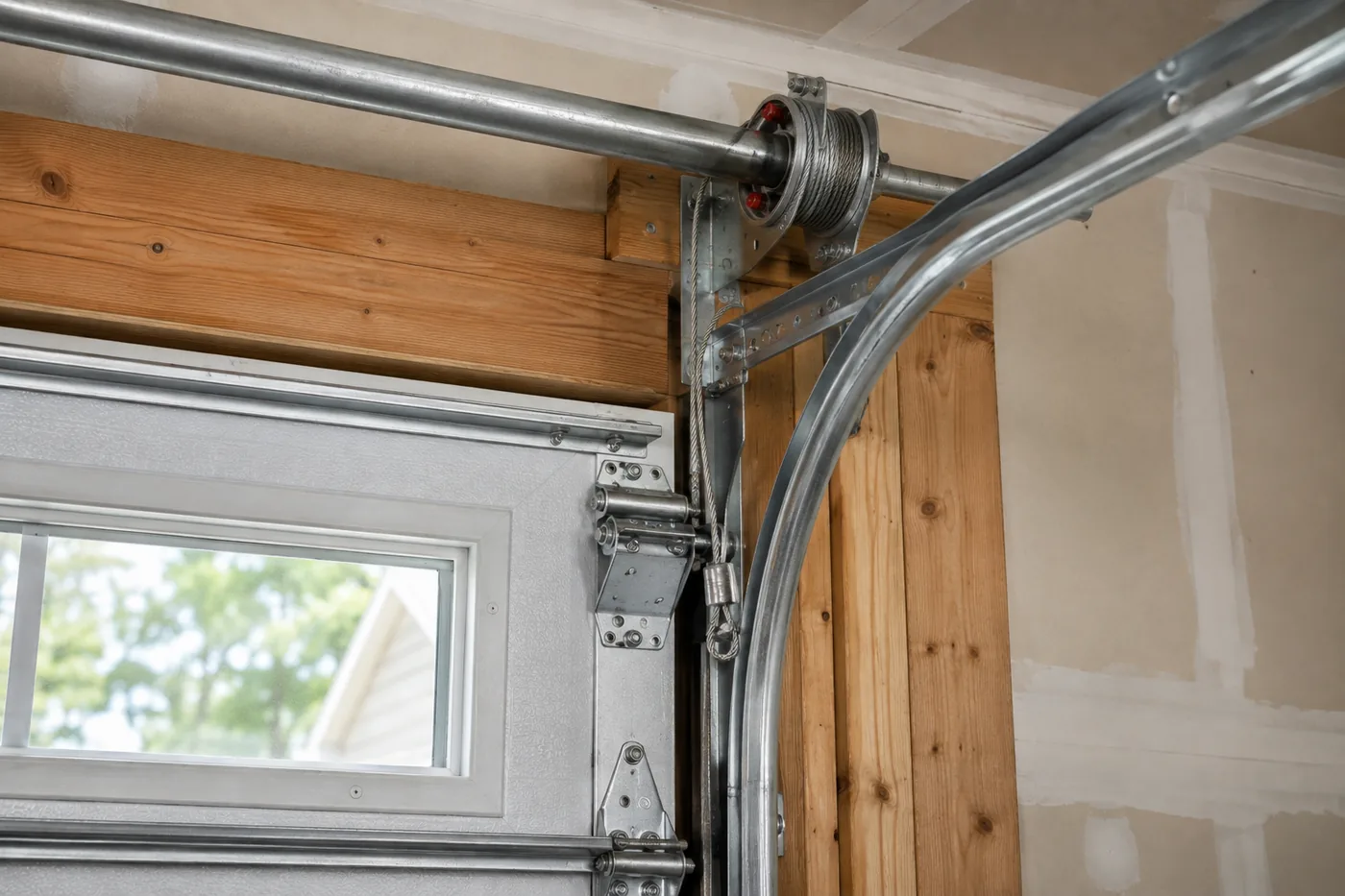
Galvanized aircraft cable running from the bottom bracket to the cable drum, transferring spring energy into the door.

How it fails
Frayed strands, a cable unwound off the drum, or a snapped cable that drops one corner and pulls the door out of the tracks.
Specification
Typically 1/8 in. 7x7 galvanized cable, length cut to door height. Always replaced as a matched pair.
Service life
Eight to fifteen years; shortest where water pools on the garage floor and wicks up the bottom fixture.

Garage door cable drum

Cable Drums

Grooved aluminum drums on each end of the torsion shaft that meter cable on and off as the door travels.

How it fails
Set screws work loose, the drum slips on the shaft, and the door immediately runs crooked or binds in the tracks.
Specification
Matched to door height — standard 7 ft, 8 ft and high-lift drums are not interchangeable.
Service life
Twenty years or more. Usually replaced because of a slipped set screw or a scored groove, not wear.

Garage door torsion shaft and bearing plate

Torsion Shaft & Bearings

The steel tube carrying the springs and drums, supported by end bearing plates and a centre bearing bracket.

How it fails
A rhythmic squeal or grinding at the header, visible shaft wobble, and eventually a shaft that scores its own bearing seat.
Specification
1 in. or 1-1/4 in. solid or tubular shaft with sealed or bushing bearings; heavier doors get the larger shaft.
Service life
Bearings ten to fifteen years, shafts far longer. Bearings get replaced whenever springs are changed on an older door.

Garage door roller

Rollers

The wheels on each hinge that carry the door section through the track.

How it fails
Flat spots, seized bearings, a rattling door and black rubber or steel dust streaking down the tracks.
Specification
Sealed 13-ball nylon rollers on 4 in. or 7 in. stems. Nylon runs quieter and lasts far longer than unsealed steel.
Service life
Steel rollers three to seven years; sealed nylon ten to fifteen. The cheapest meaningful noise upgrade on any door.

Garage door hinge

Hinges

Numbered steel plates joining sections and holding roller stems at the correct depth.

How it fails
Cracks around the roller barrel, elongated screw holes, and a metallic snap each time the door hits the curve.
Specification
Numbered 1 through 5 by position; the number sets the roller offset. Using the wrong number pulls the section out of the track.
Service life
Fifteen to twenty-five years. Centre hinges on wide doubles crack first because they carry the most flex.

Garage door track

Vertical & Horizontal Tracks

Formed steel channels guiding the rollers up the jamb and back along the ceiling, joined by the radius curve.

How it fails
Dents, a spread or pinched track width, loosened lag bolts, or a bent curve that stalls the door at the same point every time.
Specification
2 in. residential track in 12, 14 or 16 gauge, with standard, low-headroom or high-lift radius depending on the ceiling.
Service life
Decades, unless struck. Straightening a badly kinked curve is a false economy — the section gets replaced.

Garage door bottom bracket

Bottom Brackets & Fixtures

The load-bearing bracket at each bottom corner that anchors the lift cable to the door.

How it fails
Rust from standing water, a bent flange, or a bracket pulling out of the bottom section — the highest-tension part on the door.
Specification
Heavy-gauge galvanized fixtures matched to the section thickness. Never unbolted while the springs are under tension.
Service life
Fifteen to twenty-five years; corrosion, not fatigue, is what usually ends them.

Garage door top bracket

Top Brackets & Rollers

The adjustable bracket on the top section that sets how tightly the door seals against the header.

How it fails
Bent from a door forced off track, leaving a daylight gap at the top or a section that catches on the header.
Specification
Slotted for in-and-out adjustment; the top roller stem length is set by the header clearance.
Service life
Long-lived, but routinely bent during off-track incidents and replaced alongside the tracks.

Garage door strut

Struts & Reinforcement

Horizontal steel U-channel bolted across a section to stop it bowing under its own width or opener force.

How it fails
A visibly bowed top section, or a door that flexes in the middle as the opener starts the lift.
Specification
14 or 16 gauge channel sized to the door width; a strut on the top section is required on most doors driven by a trolley opener.
Service life
Permanent once fitted correctly. Missing struts are one of the most common faults we find on builder-grade doors.

Garage door weather seal

Weather Seals & Bottom Astragal

The bottom rubber astragal plus the perimeter jamb and header stop that close the opening against water, wind and vermin.

How it fails
Cracked, flattened or torn rubber, daylight at the corners, and windblown rain or leaves crossing the threshold.
Specification
T-end, bulb or U-shaped astragal to match the bottom retainer, with vinyl jamb seal on the stops.
Service life
Five to ten years for the bottom seal in New Jersey freeze-thaw cycles; jamb seal lasts longer.

Garage door section

Sections & Panels

The individual horizontal sections that make up the door face and carry the insulation core.

How it fails
Impact dents, creases along the hinge line, rust through at the bottom section, or delamination on composite faces.
Specification
Ordered by manufacturer, collection, panel pattern, gauge, insulation and finish — all four have to match to blend with neighbours.
Service life
Twenty to thirty years. Single-section replacement is realistic while the line is still in production.

Garage door lock

Locks & Slide Bolts

Interior slide bolts, side latches and keyed handle sets on doors without an opener.

How it fails
A bolt left engaged while the opener runs — which is how bent tracks and torn bottom brackets happen.
Specification
Slide bolts with opener interlock switches on manual doors; keyed T-handles on detached garages.
Service life
Decades. We disable or interlock any bolt on a door that has an opener fitted.

Garage door safety sensor

Photo-Eye Safety Sensors

The paired beam sensors six inches off the floor that reverse the door if anything crosses the opening.

How it fails
A door that closes then reverses, with a blinking LED on one sensor — misalignment, sun glare, a kinked wire or a failed eye.
Specification
Federally required on every opener since 1993. Mounted at or below 6 in. and wired back to the motor head.
Service life
Ten years plus. Alignment and wiring cause far more failures than the sensors themselves.

Garage door opener hardware

Opener Arms, Rails & Brackets

The door arm, trolley, rail and header bracket that connect the opener to the top section.

How it fails
A rattling rail, a stretched or slack chain, a trolley that disengages, or a header bracket pulling loose from the framing.
Specification
Matched to the opener model and drive type; the door arm must be bolted to a strutted or reinforced top section.
Service life
Fifteen years plus, though a worn trolley or stretched chain is a routine mid-life service item.

The Door Is A Balanced System

A sectional garage door is the heaviest moving object in most houses, and it moves only because a spring package is holding almost all of its weight. Every other component exists to route that stored energy safely: cables carry it, drums meter it, brackets anchor it, tracks guide it, rollers reduce friction and hinges hold the sections in the right plane.

That interdependence is why parts rarely fail alone. A snapped spring drops the full weight of the door onto cables and bottom brackets that were never sized for it, so a spring call frequently turns up flattened rollers, a bent top bracket and a cable that has jumped its drum. Replacing only the obvious part leaves the door running on components that already absorbed a shock load.

  • Springs and cables are the tensioned, life-limited parts
  • Rollers and hinges are the wear parts
  • Tracks and brackets are the structural parts
  • Seals and hardware are the maintenance parts

More on this: Garage Door Spring Repair · Garage Door Cable Repair.

What We Carry On The Truck

Our vans stock torsion springs across the common wire sizes, lift cables, drums, sealed nylon rollers, numbered hinges, end and centre bearings, bottom and top fixtures, struts, bottom seals and opener hardware. That inventory is the reason the large majority of New Jersey service calls finish on the first visit rather than becoming a parts-order appointment.

What we do not carry is sections. Panels are ordered by manufacturer, collection, gauge, insulation and finish, and getting a blend that matches the rest of the door means ordering the correct one rather than the closest one.

More on this: Emergency Garage Door Repair.

Parts We Will Not Reuse

Some components get replaced rather than adjusted, and we would rather explain that up front than argue about it in a driveway. Springs that have already broken, cables with broken strands, bottom brackets with rust perforation and hinges cracked around the roller barrel all belong in the van, not back on the door.

Everything we fit is a full-specification part rather than a hardware-store equivalent. Call (888) 706-5757 if you want a part identified before you order anything yourself.

FAQ

Garage Door Parts FAQ

  • Four measurements: wire diameter, inside diameter, overall length and wind direction. Guessing any one of them gives you a door that is either too heavy to lift or one that flies open. We measure on site and match the spring to the door's actual weight rather than to a catalogue assumption.

Request garage door service

Send the details and we'll get back to you. Broken spring or door stuck? Call (888) 706-5757 — we answer 24/7.

Security check

This form is protected against automated spam submissions.

Call (888) 706-5757

24/7 Garage Door Service

Need a garage door part identified or replaced? Call (888) 706-5757.

One call reaches a garage door specialist, not a call center. Tell us what the door is doing and we'll tell you what it takes to fix it.

Call Now Get Estimate