Built on a proven platform
The 139-series shares its internals with openers that are still supported today, so a twenty-year-old Craftsman is far more repairable than its age suggests.
Open 24/7|24/7 Emergency Garage Door Service Across New Jersey
New Jersey · Open 24/7
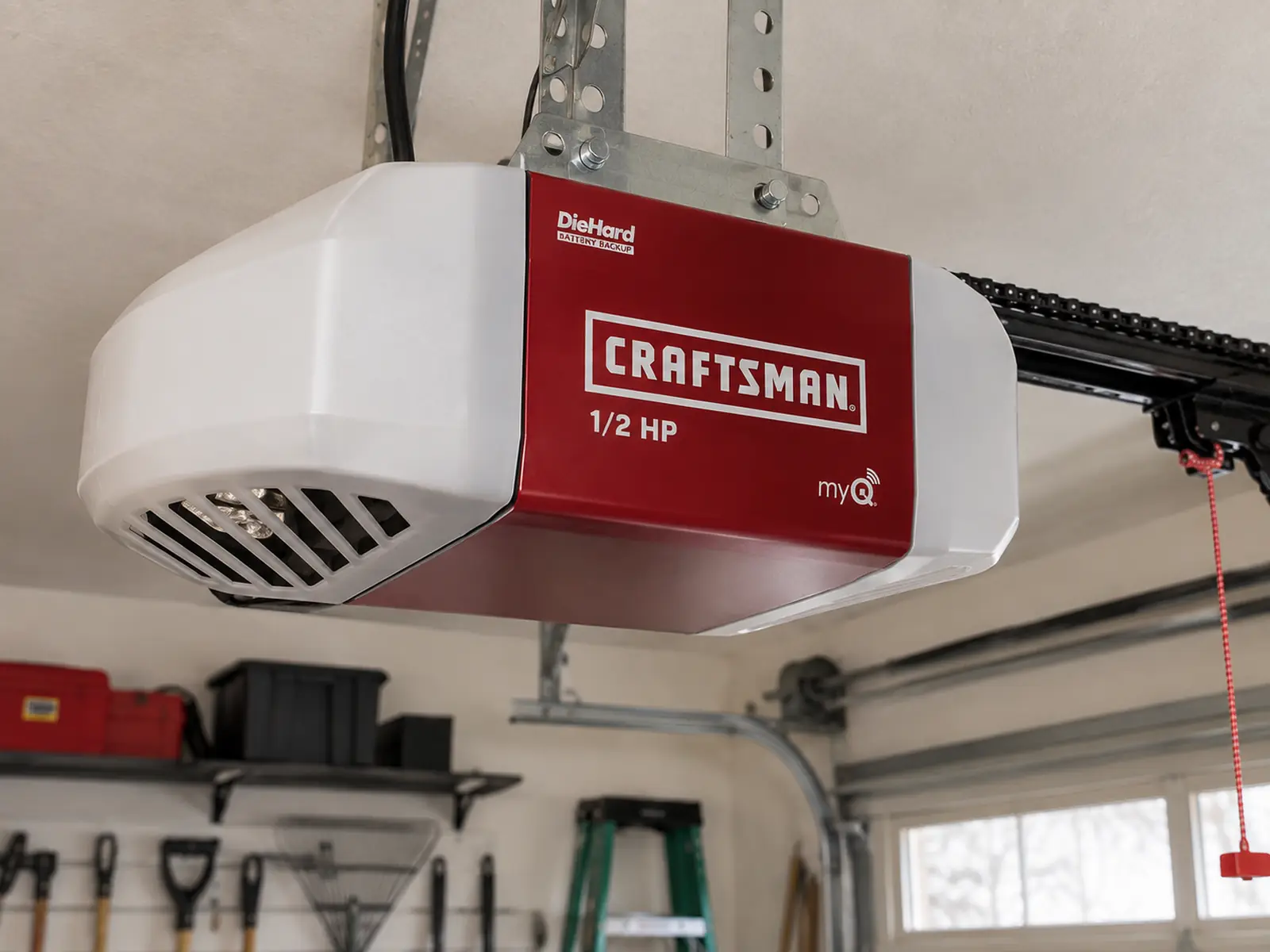
Craftsman openers sold by the thousand through Sears, and plenty of them are still running above New Jersey garages today.
Craftsman openers were manufactured under licence — the classic 139-series heads are Chamberlain Group builds wearing a Sears badge, while the newer CMXEOCG units come from the current Craftsman ownership. That heritage is the key to servicing them: once we identify which platform your head is built on, the parts and the diagnostic tree follow immediately.
Ace Garage Door Service keeps servicing Craftsman openers long after the Sears counter closed. We source gear kits, sensor pairs, boards and remotes for the 139 series, and we handle the current CMXEOCG line as a standard installation and repair item.
The 139-series shares its internals with openers that are still supported today, so a twenty-year-old Craftsman is far more repairable than its age suggests.
There is very little exotic in a Craftsman head. Gear, sprocket, board, sensors — a technician who understands the platform can diagnose one quickly.
Between original Sears remotes and modern universal units, getting a working remote for a Craftsman is rarely a problem.
When a Craftsman finally does die, the mounting layout usually accepts a modern replacement with minimal structural work.
The signature Craftsman failure is identical to its platform cousins: a chewed nylon gear that leaves the motor spinning and the door motionless. On the 139 series the gear kit is inexpensive and the repair is quick, provided the door itself is not the reason the gear died. We always test the balance before fitting a new gear, because a heavy door will destroy the replacement inside a year.
We also see a lot of Craftsman sensor faults where the original wiring has been stapled to the wall and the staple has cut through the insulation over time, plus receivers that stopped responding to remotes after the board aged.
When we install a current Craftsman CMXEOCG unit, the process mirrors any professional installation: balance the door, mount into structural framing, square the rail, set sensors low, program the remotes and keypad, and test the safety reverse against a flat board.
On homes where an old 139-series is coming down, we take the opportunity to correct the original mounting. Sears-era installations often used lightweight perforated strap that has been flexing for two decades, and replacing it with rigid angle removes most of the noise people blame on the opener itself.
A Craftsman head with a failed board and a worn gear is generally past the point of sensible repair, particularly on pre-1993 units without rolling-code security. Those older remotes use a fixed code that can be captured from the street, which is reason enough to replace regardless of how well the motor still runs.
We replace with either a current Craftsman unit or a LiftMaster equivalent depending on what you want from the opener. Both mount cleanly in the same space, and we recycle the old head as part of the job.
Older Craftsman units reward attention because their failure modes are so predictable. We check gear condition, re-tension the chain, grease the rail, verify force settings, and inspect every inch of the sensor wiring for staple damage.
We also check the mounting hardware carefully on these units. Two decades of vibration loosens lag bolts, and a header bracket that has started to pull is a genuine hazard rather than a cosmetic issue.
Motor runs, door stays put
Stripped nylon gear — the classic 139-series failure.
Door will not close, light bulb flashes
Sensor beam broken, misaligned, or a wire cut by an old staple.
Remote works, wall button does not
Shorted or broken low-voltage wire between console and head.
Door reverses on closing every time
Down-force set too low, or the door binds in the track near the floor.
Grinding noise at start of travel
Worn sprocket, loose chain, or a dry rail.
Opener works intermittently in cold weather
Aging capacitor losing capacity, common on older 139 units.
Models We Service
Craftsman models Ace regularly services in New Jersey. On the 139-series the number is stamped on a silver label on the end panel — read the whole string including the digits after the decimal point.
1/2 HP chain drive, very common Sears-era unit.
Chain drive with rolling-code remote system.
Older 1/2 HP chain drive, parts still available.
Current-generation chain drive with smart control.
Belt drive, quieter option for attached garages.
3/4 HP belt drive with WiFi and battery backup.
FAQ
For the 139-series, usually yes — gear kits, sensors, boards and remotes are all obtainable because the platform is shared with openers that are still supported.
24/7 Garage Door Service
One call reaches a garage door specialist, not a call center. Tell us what the door is doing and we'll tell you what it takes to fix it.